By the first century AD, Pompeii was a prosperous Roman town of perhaps 10,000 to 12,000 people, situated near the Bay of Naples and the mouth of the Sarno River. Its streets followed a roughly regular grid and were marked by deep ruts left by cart traffic. Shops and businesses lined the roads, including thermopolia, establishments that sold prepared food and drink, as well as bakeries, laundries, and workshops. Walls throughout the city carried graffiti ranging from election notices and advertisements to insults, love messages, and other everyday observations. Wealthier residents lived in houses and villas arranged around open courtyards, gardens, and atria decorated with elaborate frescoes, while poorer inhabitants often lived in smaller rooms above or behind shops. Pompeii had a central forum, theaters, an amphitheater, and several public bath complexes. Mount Vesuvius dominated the landscape, but the volcano had been dormant for centuries. Its long period of inactivity may have left many residents unaware that the mountain was capable of a major eruption.
That changed in AD 79, when Vesuvius produced one of the most destructive volcanic eruptions in Roman history. Ancient sources traditionally place the eruption on August 24, although some modern scholars argue for a date in October based on archaeological and historical evidence. The eruption began during the afternoon with an enormous column of volcanic ash, pumice, and gas that rose many miles into the atmosphere. Over the following hours, pumice and ash fell across Pompeii, accumulating to a depth of several meters in places. The material was relatively light but accumulated heavily enough to damage and eventually collapse roofs. Many residents appear to have escaped during this phase, although others remained behind, perhaps believing the worst had passed or attempting to protect their homes and possessions.
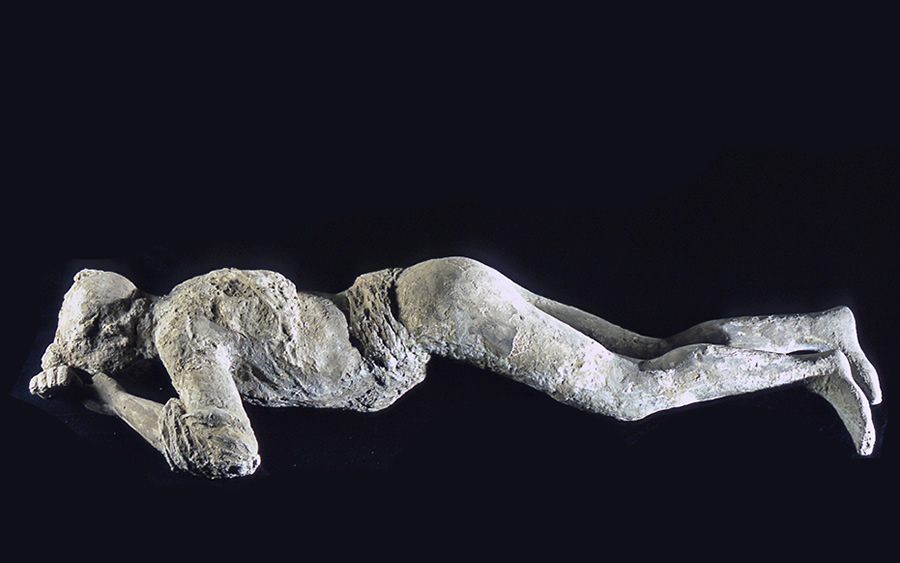
The most deadly phase came later, when portions of the eruption column collapsed and generated pyroclastic density currents, turbulent mixtures of extremely hot gas, ash, and volcanic debris that raced down the slopes of Vesuvius. These currents reached nearby Herculaneum first and later swept across Pompeii. Their temperatures and speed made them lethal to people caught in their path, killing many who had survived the earlier ashfall. The exact number of people who died at Pompeii remains unknown, although thousands are thought to have perished across the affected area. Excavators later discovered cavities left where victims' bodies had decomposed within the hardened volcanic deposits. Beginning in the nineteenth century, archaeologists filled some of these cavities with plaster, creating casts that preserved the positions and, in some cases, remarkable details of people caught in the disaster.
79 AD
Year Vesuvius erupted
~11,000
Residents at its height
1748
Excavation begins
109 acres
Uncovered to date
7th–6th c. BC
Founded near the Sarno river by the Oscans, later shaped by Greek and Samnite settlers.
89 BC
Becomes a Roman colony — the forum, baths, and amphitheatre take shape.
62 AD
A severe earthquake rattles the region. Repairs are still underway seventeen years later.
Aug 24, 79 AD
Vesuvius erupts. Within a day, Pompeii lies under six meters of ash and pumice.
1748
Systematic excavation begins under Charles of Bourbon, and the city resurfaces.
Two days that sealed a city in time
On the morning of August 24, Vesuvius sent a column of ash and pumice more than 20 miles into the sky. It rained down on Pompeii for hours. Then, the next day, surges of superheated gas swept through the city, ending thousands of lives in moments.
Roughly 2,000 people perished. Yet the same ash that killed them also buried and preserved the city, shielding it from time, light, and looters, and allowing so much of Pompeii to survive to this day.
Pompeii today
Hours
Open daily except Dec 25 and Jan 1. Closes earlier in winter months, later in summer.
Getting there
The Circumvesuviana train from Naples stops at Pompei Scavi-Villa dei Misteri, steps from the entrance.
Tickets
Book ahead in peak season; a combined ticket also covers nearby Herculaneum.
Plan for
At least half a day — the site covers 44 hectares. Wear sturdy shoes and bring water and sun protection.
Three places to start
The Forum
The civic and religious heart of the city, ringed by temples and markets.
The Amphitheatre
One of the oldest surviving Roman amphitheatres, built around 70 BC.
Villa of the Mysteries
A grand suburban villa famed for its vivid, still-vibrant frescoes.
A walk through the ruins
“Ashes were already falling, not as yet very thick. I looked back: dense fumes were rolling behind us.”